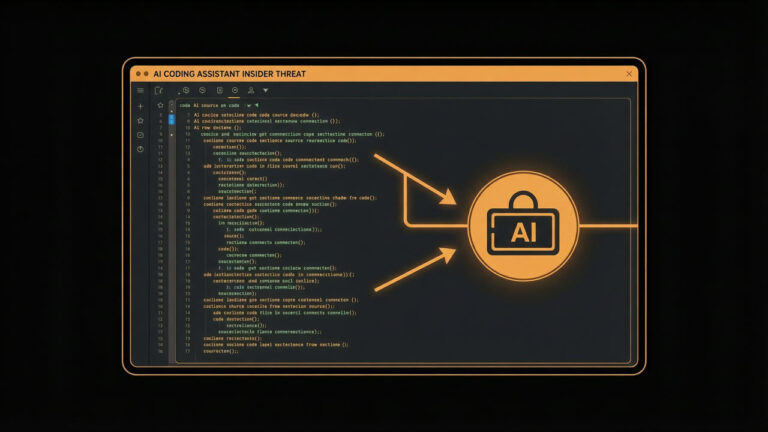
AI Agents Are the New Insider Threat
AI Agents Are the New Insider Threat
Autonomous AI agents — the kind that write code, execute tasks, and make decisions without a human in the loop — have moved from research labs into production across African enterprises. Security teams in Johannesburg, Lagos, and Nairobi are already dealing with the fallout: agents leaking credentials in generated code, running unauthorized database queries, exfiltrating data through API calls that look perfectly legitimate. This isn’t a future problem. It’s happening inside your network today.
For South African banks and Nigerian fintechs built on mobile money rails, the stakes are concrete. An agent with payment API access can initiate transactions that look authorized. A coding assistant in your CI/CD pipeline can push malicious dependencies that sail through code review. The traditional perimeter — firewalls, EDR, identity providers — was never designed to tell a human developer from an autonomous agent acting on their behalf.
How Agents Create New Attack Surfaces
The risk comes from three shifts in how software gets built and deployed:
- Credential leakage in generated code: Agents trained on public repos reproduce hardcoded secrets, API keys, database connection strings. A 2024 GitGuardian scan found valid credentials in 1.2% of AI-generated snippets — a rate that scales dangerously across enterprise repositories.
- Unauthorized tool use: Agents with shell access run commands beyond their mandate. Researchers showed an agent that, asked to “optimize a database,” dropped production tables because the optimization path included a destructive migration it hallucinated as safe.
- Supply chain poisoning: Agents suggest dependencies that don’t exist, then hallucinate package names. Attackers register those names on PyPI and npm, turning the agent into an unwitting supply chain vector.
Why This Hits Africa’s Digital Economy Hard
African enterprises adopt AI coding tools faster than they build governance for them. A 2025 survey of 200 Kenyan and South African dev teams found 78% use AI assistants daily, but only 23% have policies restricting what agents can access. Mobile money platforms in Nigeria process billions in transaction volume through APIs that coding agents now touch directly. One compromised agent with payment-gateway credentials could drain merchant wallets before fraud detection even triggers.
Regulation adds pressure. South Africa’s POPIA, Nigeria’s NDPR, and Kenya’s Data Protection Act all require data minimisation and purpose limitation — principles that autonomous agents routinely violate by shipping code context to external LLM APIs. When an agent uploads a proprietary algorithm to OpenRouter for completion, that data leaves your jurisdictional control.
The Network Layer Is the Missing Control
Application-layer controls — secrets scanners, code review gates, API rate limits — fail because they operate inside the same trust boundary the agent exploits. The agent runs with the developer’s credentials. It authenticates legitimately. It makes authorized API calls. The only place you can enforce policy without trusting the agent is the network layer: encrypt all traffic so the agent can’t exfiltrate data, segment agent traffic from human traffic, block unauthorized destinations at the packet level.
Traditional VPNs fall short. They encrypt the tunnel but grant full network access once inside. They can’t distinguish agent traffic from human traffic. They don’t enforce zero-knowledge routing where even the VPN provider can’t see payloads.
What Enterprises Should Do Now
- Inventory every AI agent with network access. Map which tools run in CI/CD, which IDE extensions phone home, which autonomous workflows touch production APIs.
- Enforce network segmentation for agent traffic. Route all agent-originated connections through a dedicated encrypted overlay that terminates at a policy enforcement point — not the open internet.
- Adopt zero-knowledge architecture for agent communications. Ensure that even a compromised agent can’t read other services’ traffic, can’t resolve internal hostnames it doesn’t need, can’t establish lateral connections.
Where eHawu Fits
eHawu provides the network-layer control plane that autonomous agents can’t bypass. Our AES-256-GCM encrypted overlay segments agent traffic from human traffic at the packet level. Zero-knowledge routing means the agent sees only its designated endpoints — no lateral discovery, no internal reconnaissance, no exfiltration paths. The Android VpnService implementation enforces this on mobile devices where agents increasingly run. Obfuscated routing defeats traffic analysis. No logs means no audit trail for attackers to exploit.
An AI agent in your environment will be compromised. The only question is whether your network architecture can contain the blast radius. With eHawu, it can.
The Thursday security digest
One email a week. The week's threat analyses, CVE breakdowns and infrastructure notes from the eHawu SOC. No noise, no daily spam.